
Job Simulations, Practical Training and Virtual Internships: What Is the Difference?
17 November 2026 · 7 min read
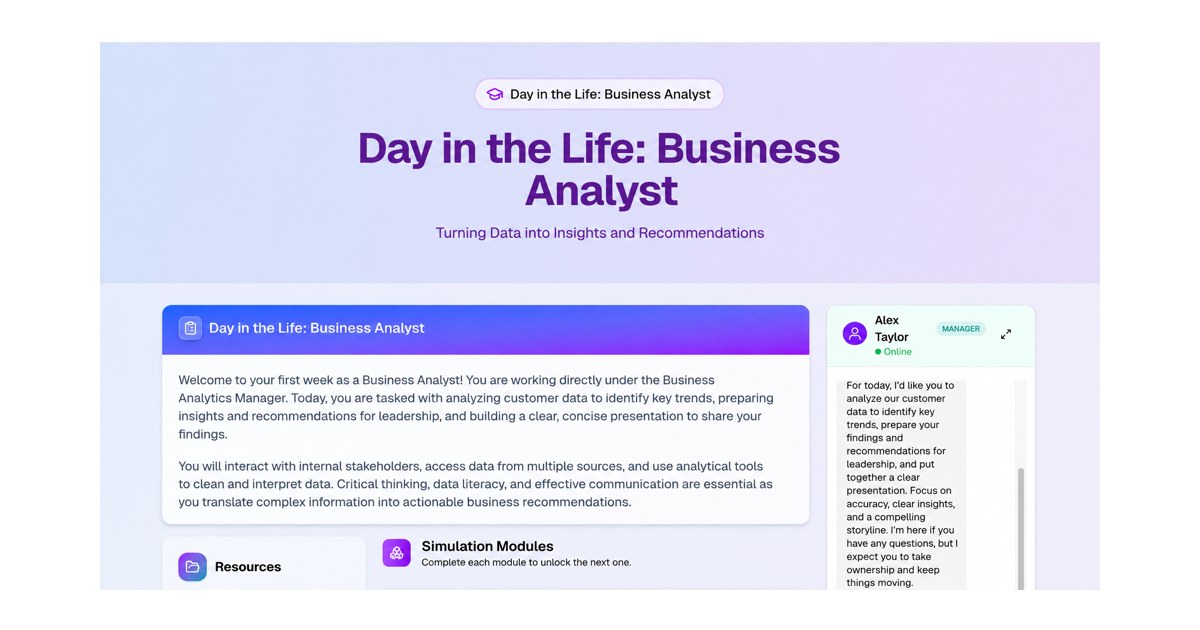
A job simulation lets you practise tasks from a role in a designed scenario. Practical training is the broader category of learning by doing. A virtual internship usually means a placement carried out remotely with a host organisation, although some providers use the term for self-paced simulations. For students and universities in Saudi Arabia and the United Arab Emirates, the important question is what the participant actually does, who reviews the work and whether the experience meets the programme’s requirements.
What is a job simulation?
A job simulation is a structured activity that recreates selected tasks and decisions from a professional role. Instead of only watching a lesson, the learner responds to a brief, analyses information or submits work. Feedback helps them understand how their performance compares with the activity’s criteria. A simulation is practice in a constructed setting, not employment or a placement with the company whose type of work it illustrates.
What does practical training mean?
Practical training develops skills through tasks, practice and feedback rather than explanation alone. It can include supervised workplace placements, workshops, projects, laboratories and digital job simulations. The format matters less than having a clear task, an appropriate level of difficulty and a way to review the work. Completing an activity does not by itself prove mastery of a skill.
Is a virtual internship the same as a job simulation?
Not necessarily. In a remote internship, a host organisation normally supervises an intern who contributes to its work. In a self-paced job simulation, a learner completes designed tasks rather than working as an intern for a host. Because providers use “virtual internship” differently, check the supervision, live work, hours, assessment and recognition before enrolling. SkillStep is a workplace simulation platform; completing a SkillStep scenario should not be described as employment or a guaranteed internship placement.
Which format should a student choose?
- Career exploration: use a job simulation to try tasks from a role before applying.
- Focused skill practice: choose a project, workshop or simulation with relevant feedback.
- Experience in a real organisation: look for a supervised internship with a verified host.
- University credit or required placement hours: obtain approval from your university before choosing any format.
What is an example of simulation-based practical training?
Consider an illustrative business analyst task: a manager asks why customer complaints increased. The learner reviews a fictional dataset, identifies patterns and writes a short recommendation. A reviewer can assess the analysis, prioritisation and clarity of communication against agreed criteria. This is a sample learning activity, not a promise that a particular simulation is currently available on SkillStep. Check the live catalogue for each scenario’s actual tasks, duration and feedback.
Where can I find job simulations in Saudi Arabia and the UAE?
SkillStep is one option for learners and institutions exploring scenario-based practical training. It assesses performance through realistic workplace scenarios and feedback. Its public catalogue lists available simulations and their current details. Universities and training centres in Saudi Arabia and the UAE can discuss how these activities could complement their existing programmes; they should separately verify curriculum fit and any credit or accreditation requirements.
Browse SkillStep’s current job simulations
How should a university evaluate a practical training platform?
- Tasks: what will learners produce, and does it reflect the intended role?
- Feedback: who reviews the work, what criteria are used and what can learners improve?
- Access: check language, accessibility, device needs and expected time for each activity.
- Privacy: ask how learner submissions and assessment data are handled.
- Recognition: verify any claims about credits, certificates or placements with the responsible institution.
- Cost: review current individual simulation prices or institutional plans before committing.
Compare SkillStep institutional plans and prices
Can job simulations help prepare for an internship?
They can provide practice with professional tasks before a placement, particularly when learners reflect on feedback and repeat relevant exercises. Simulations do not replace the relationships, supervision or live responsibilities of a real internship, and they do not guarantee a job offer. Describe completed work accurately on a CV: name the simulation and explain the tasks and learning, rather than presenting it as employment.
Learn how SkillStep simulations work